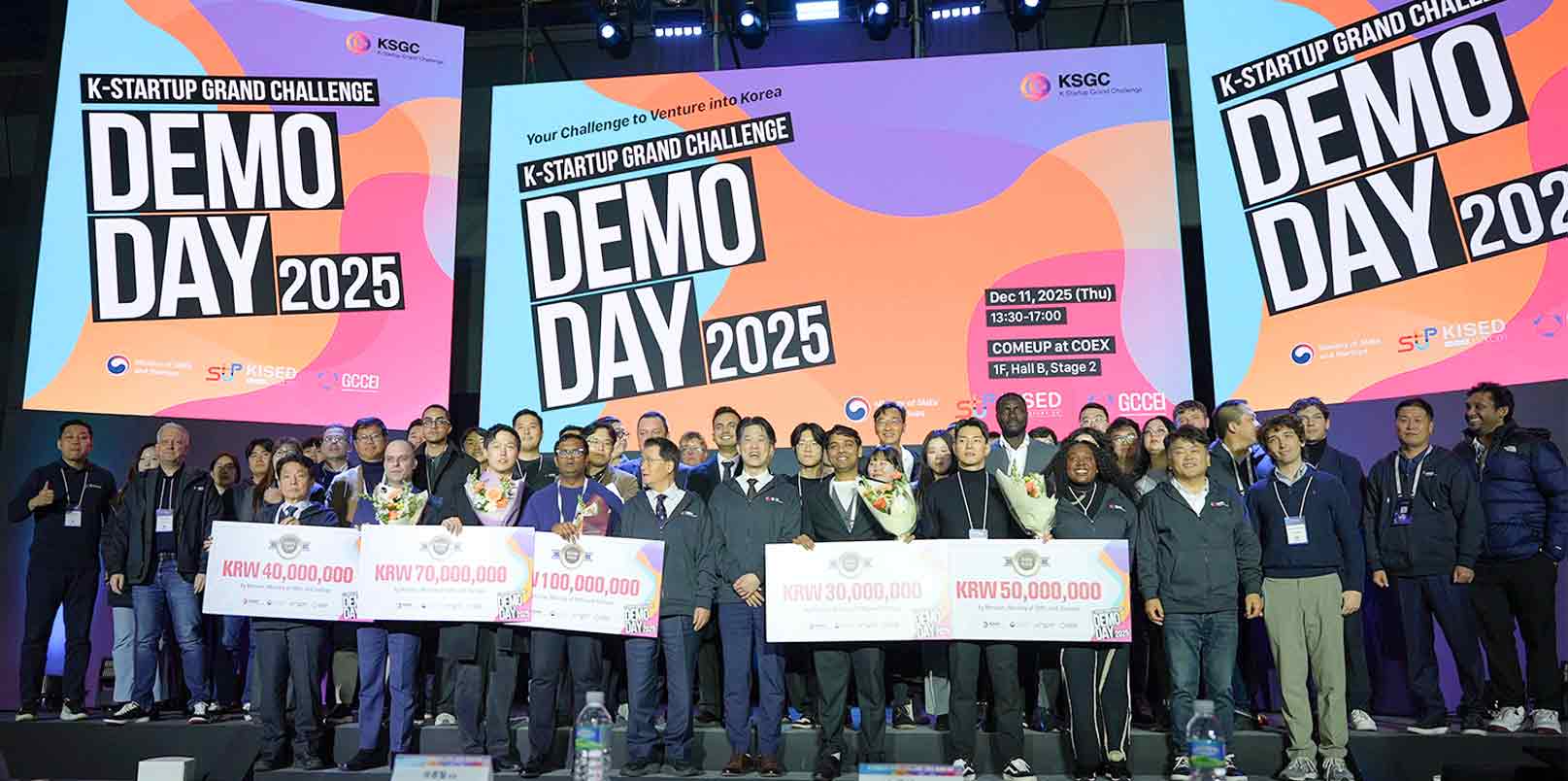
Korea’s inbound startup strategy is becoming clearer. The K-Startup Grand Challenge (KSGC) 2025 Demo Day, held on December 11 at COEX Seoul, not only offered a stage for global founders but also exposed how the nation is refining what kinds of innovation it wants to attract. The 20 Phase 3 startups show that Korea is prioritizing capability-driven technology integration over consumer novelty, shaping its next decade of global startup collaboration.
K-Startup Grand Challenge 2025 Marks a Turning Point for Inbound Innovation
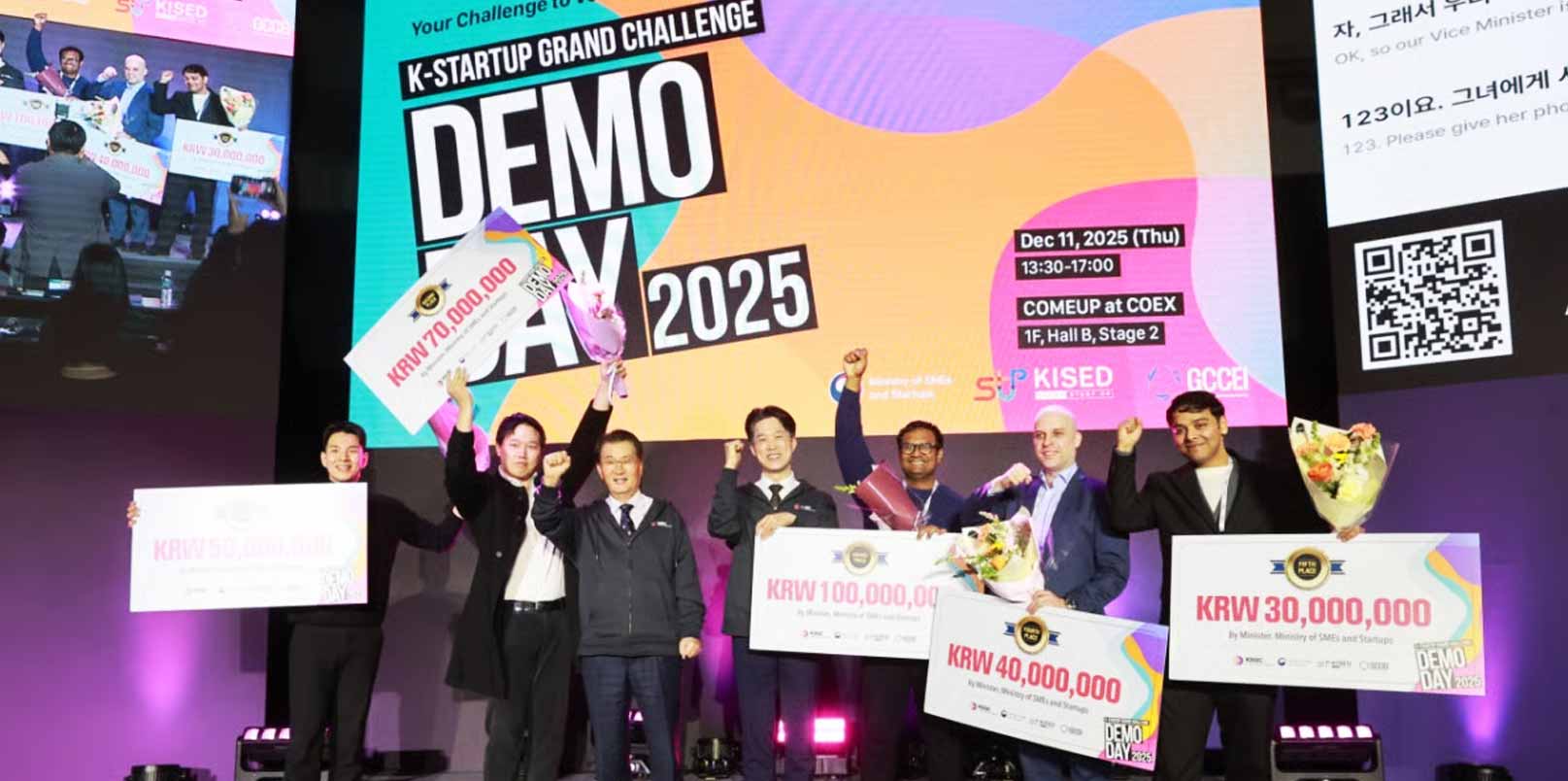
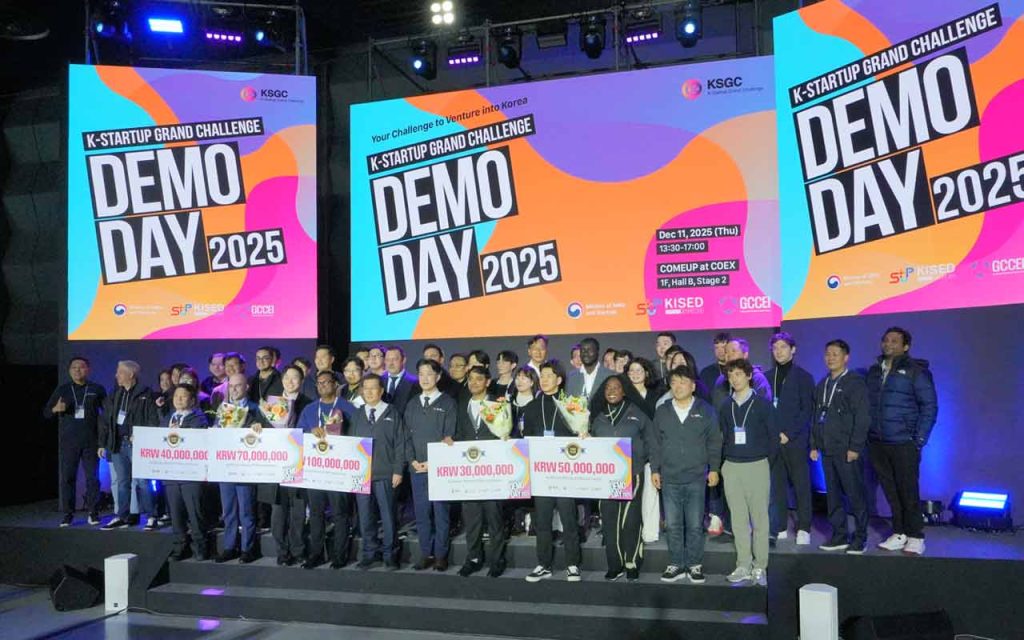
The K-Startup Grand Challenge 2025 (KSGC), Korea’s largest inbound startup competition organized by the Ministry of SMEs and Startups (MSS) and the Korea Institute of Startup & Entrepreneurship Development (KISED), concluded its Demo Day within COMEUP 2025, the nation’s flagship startup festival.
This year’s program attracted 2,626 applications from 97 countries, the highest in its ten-year history. After a multi-stage selection, 80 teams entered Phase 1, 40 advanced to Phase 2, and 20 were chosen for Phase 3, receiving extended support for Korean market entry—covering visa facilitation, business registration, and local settlement.
While India’s Konnect took the grand prize of KRW 100 million (approximately USD 66,700) for its authentication and payment platform addressing identity verification challenges for foreign residents, the broader significance lies in the Phase 3 lineup, which reveals how Korea now filters and invests in foreign-led innovation.
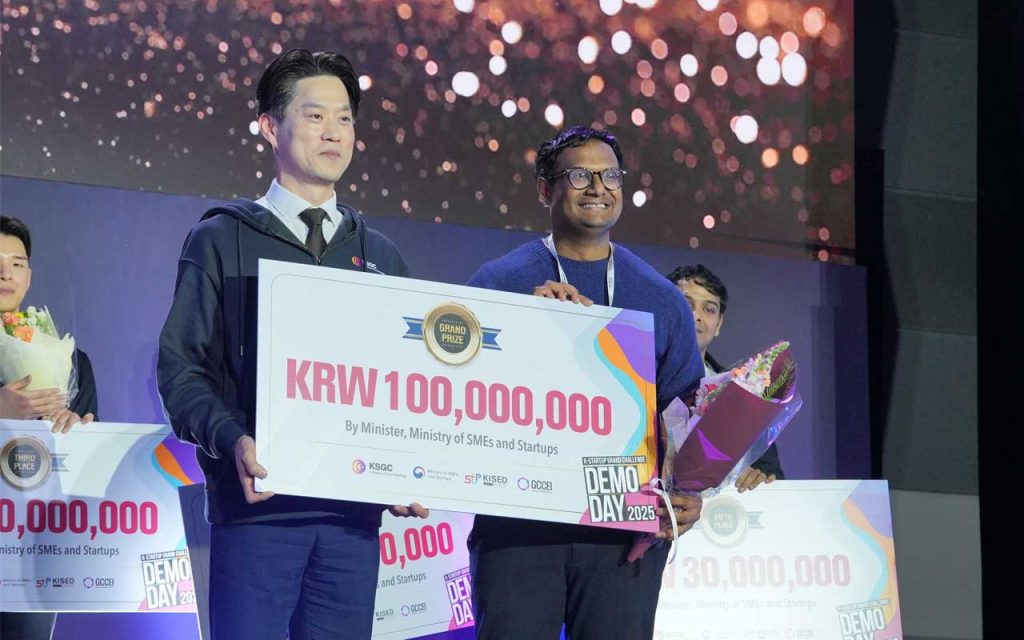
The competition also recognized MaimHaim (USA), which received KRW 70 million for its unmanned operations solution leveraging IMU sensors and Zero UI technology, and Pierrot Company (Canada), which earned KRW 50 million for its data-driven global IT asset circulation platform.
Phase 3 Startups Reflect Korea’s Technology Priorities
The 20 startups selected for Phase 3 represent a deliberate mix of infrastructure AI, cybersecurity, digital identity, healthtech, and sustainability—fields aligned with Korea’s industrial transformation and demographic needs.
Rather than focusing on consumer products, these startups demonstrate how the government’s inbound innovation policy now favors capability-driven solutions that can integrate into national systems, industries, and public services.
AI Infrastructure and Industrial Intelligence
Startups in this group strengthen Korea’s industrial backbone through predictive analytics, automation, and defect detection—fields central to the nation’s manufacturing and compliance excellence.
- Acurion: AI detecting genomic markers for precise, efficient cancer diagnosis.
- GROUNDUP.AI: Predictive maintenance platform using AI agents and sensors for industrial equipment.
- Predulive Labs: AI analytics for detecting compliance defects in infrastructure and manufacturing.
- Peris.ai: Cybersecurity orchestration platform detecting and responding to real-time threats.
- ArbaLabs: Edge AI securing aerospace and critical infrastructure through sovereign trusted technology.
Human-Centered Robotics and Care Tech
Reflecting Korea’s demographic shift toward an aging population, these startups focus on AI-assisted companionship, healthcare, and accessibility.
- Digital Human Corporation: Human-centric AI with KAi, an empathetic digital companion for elderly support.
- IDOLL Robotics: Emotionally intelligent robots designed for human companionship and learning.
- Patientory: Web3 health data management platform for secure medical record sharing.
- BION: LEO™ Gluten Sensor providing real-time food-allergy detection for dietary safety.
Identity, Trust, and Automation Platforms
These companies embody Korea’s push toward digital governance, secure onboarding, and operational efficiency for global and local users.
- Konnect: Authentication and payment super-app for foreign residents and tourists in Korea.
- Smart Contract: Workflow automation for identity and document authentication.
- MaimHaim: Zero-UI, IMU-based automation for unmanned facilities and geofencing systems.
- InsightMatches: AI SaaS automating global R&D collaboration and innovation matching.
AI-Driven Business and Creative Platforms
This category highlights AI’s expanding role in enterprise solutions, education, and the creative economy.
- Markopolo AI: Automation platform personalizing engagement through SMS, email, and WhatsApp.
- AvoLabs: AI-driven B2B EdTech tools for personalized learning automation.
- Niio: Digital art platform transforming screens into global art showcases.
Sustainability and Green Innovation
Aligned with Korea’s net-zero goals, these startups promote circular resource systems, environmental monitoring, and sustainable production.
- Protein Kapital: Producing sustainable protein and bio-fertilizer using insects and food waste.
- RIFFAI: AI environmental sensing tracking pollution and ecosystem change.
- Pierrot Company: Data-driven IT asset recovery and subscription platform enabling circular use of electronic devices.
- 3TGDS: Travel Trust Tickets enabling instant redemption across global travel and lifestyle services.
Together, these clusters reveal how KSGC has evolved into a national selection mechanism for strategic technologies—one that filters global innovation through Korea’s own industrial, social, and policy priorities.
Government Reaffirms Support for Global Founders
At the Demo Day, Vice Minister Roh Yong-seok of MSS reiterated the government’s commitment to global entrepreneurship, stating:
“We will spare no policy support to help global startups grow and succeed in Korea, and to inject new momentum into the country’s innovation ecosystem.”
This continued policy assurance reinforces KSGC’s evolution from an acceleration event into a structured inbound policy platform, where foreign entrepreneurs receive tangible, state-backed support—from visa processing and corporate setup to investor and conglomerate matching through Pangyo’s innovation infrastructure.

KSGC at 10 Years: From Experiment to Policy Engine
Since its inception in 2016, KSGC has supported over 1,000 international startups and facilitated hundreds of market entries through Korean legal entities and startup visas. Its growth mirrors Korea’s broader pivot from exporting innovation to importing capabilities—selectively integrating global startups that strengthen its industrial backbone, AI competitiveness, and digital economy.
The tenth-anniversary edition’s deeper integration with COMEUP 2025 signifies institutional maturity. What began as an experimental accelerator has become a national soft-landing infrastructure that now shapes who gets to participate in Korea’s innovation ecosystem.
Why the K-Startup Grand Challenge 2025 Cohort Matters for Korea’s Global Role
Now, the K-Startup Grand Challenge 2025 Phase 3 cohort has actually illustrated three clear policy tendencies:
- Infrastructure over apps.
Most selected startups operate in deep-tech, compliance, and enterprise solutions—signaling Korea’s focus on scalable, regulation-compatible technologies. - Public-sector adjacency.
Several solutions align with national needs such as aging population support (Digital Human Corporation, IDOLL Robotics), cybersecurity (Peris.ai), and green economy (Protein Kapital). - Governance-linked innovation.
Platforms like Smart Contract and Konnect tackle identity, documentation, and financial inclusion—issues directly tied to Korea’s administrative modernization goals.
And so, this points to one conclusion: Korea’s inbound door remains open but strategically filtered for ecosystem contribution.
The Shape of Korea’s Next Startup Decade
K-Startup Grand Challenge 2025 shows that Korea’s inbound startup policy is no longer experimental—it is now fully engineered. The country now seeks technology partners who can integrate into its industrial and regulatory systems, not just startups looking for acceleration.
Investors are now watching that Korea double down on infrastructure over innovation theater. The capital is moving toward systemic value creation, not short-term showcase innovation. At the same time, the KSGC 2025 startups also show global founders what qualifies as “strategic fit” in one of Asia’s most structured innovation ecosystems.
KSGC’s 10th anniversary thus defines a new frontier: a Korea that imports innovation selectively, accelerates capability, and exports global competitiveness.
– Stay Ahead in Korea’s Startup Scene –
Get real-time insights, funding updates, and policy shifts shaping Korea’s innovation ecosystem.
➡️ Follow KoreaTechDesk on LinkedIn, X (Twitter), Threads, Bluesky, Telegram, Facebook, and WhatsApp Channel.
🤝 Looking to connect with verified Korean companies building globally?
Explore curated company profiles and request direct introductions through beSUCCESS Connect.